I sometimes imagine that, through some miracle of time travel, I am host to Thomas Jefferson, Thomas Paine, Merriwether Lewis, and William Clark. I know, it's a stretch. My apartment can hardly handle two people and a dog, much less four guests, but, hey, are my space constraints really the biggest obstacle to making this happen!
I wonder if anything these men would see in our society would give them pride that they had set this chain of events in motion. For the life of me, I cannot come up with one thing that they might appreciate.
Jefferson had envisioned a land of well-read, well-informed farmers. We are none of these three. We are the most poorly educated and poorly informed populace among the developed nations. Very few of us work the land. Jefferson's nemesis, Andrew Jackson, with his emphasis on banking, finance, and commerce, has won out over Jefferson's vision. With this Jacksonian triumph has come the stock market, commodities, and housing bubbles, as well as a great redistribution of wealth from the lower and middle classes to the ungodly wealthy.
Jefferson also was a strong believer in a free press, contending that if he had to choose between government and a free press, he'd choose the latter as it is far more important to the functioning of democracy. How horrified he would be with government collusion with corporations and corporations' stranglehold on information.
Thomas Paine, who would be a radical even today, would doubtless rail against Homeland Security, the military-industrial complex, the oil-spy-military-banking cabal, surveillance of all kinds, the trashing of the Constitution, an elite establishment that rules our government, and plans to scrap help for the elderly, the poor, and the sick. In "Rights of Man," which I recently read, Paine advocates for guaranteed retirement (Social Security), health care for those who can't afford it, and cutting the armed forces almost back to nothing. He strongly pushes for progressive taxes, i.e. taxing the rich heaviest and the poor not at all.
Lewis and Clark would be utterly despondent. How could all this vast, beautiful, untouched wilderness be gobbled up by hoardes of people, their structures, their vehicles, and their things in just 200 years? What a cancer humanity is to so utterly destroy paradise in such short order!
All four would find the lack of quiet unnerving, the poor quality of food and water outrageous, and the lack of civility and the overwhelming insanity of hyper-consumerism, materialism, selfishness, greed, and general unhappiness devastating to their psyches as they are to mine.
If these men ever do show up on my doorstep, I will keep them close by so that when they are beamed back to their time, I can go with them.
Monday, February 07, 2011


Wednesday, February 02, 2011
Acutely Aware that I Don't Have a Man by my Side
Yesterday morning I was acutely aware that I don't have a man by my side. Every so often this happens, generally when a man is a jerk to me, and I know he would be far less of a jerk or even downright respectful if I was not alone.
The maintanence man has been angry at me for more than a week, every since my friend Rick, who is a plumber, gave me a laundry list of what's unsafe and unhealthful around my apartment. Most of these items would be clear to anyone, even those who don't know a hammer from a nail. Things like the threshold that's in several pieces and the termite-riddled porch railing, things I noted when I first moved in.
As yesterday was the first of the month, rent was due. I told the young guy who picks up the checks that I was writing a note and my envelope would be ready in a few minutes. Before I could finish, let's-call-him-Don, who must have been waiting in the truck, stormed up to the door and started yelling at me. I pointed out that the crawl space at the back of the house had been wide open for more than a week, creating a superhighway for rodents. Don said that he had left it off for the plumber who is supposed to reposition the dryer vent so that it discharges water and heat outside the house rather than under my bedroom. I wondered why it was taking so long to find a plumber. Don said he didn't know when he was coming. I wondered why the plumber couldn't loosen a few screws to access the crawl space. Don said that this was "building work," something beyond the purview of a plumber. I couldn't believe this. You mean if a plumber went to a job site and found a secured crawl space, he would be dumbfounded and wouldn't know how to use a screwdriver! I just hate it when people lie like this to me.
When I said that I had called five times about rats since moving in and that nothing more than placing poison and setting traps was accomplished, Don started yelling, three times in a row, "You should move!" I said it would be much cheaper and efficient to just fix the places where the rats are gaining access--the unsecured crawl spaces and the gaps between the boards. But this of course involves too much effort.
After he left, I cried for about 15 minutes. It's difficult enough to sleep alone every night, go on a date maybe once or twice a year, sometimes not at all, never have a partner with whom to attend parties or dinners, never have the back of my neck kissed or my hand held or my feet rubbed, but to be treated as a second-class citizen on top of that!
Once in a while it's overwhelming that I've missed out on so many of life's "biggies"--health, love, relationship, support from my family of origin, social life, satisfying career, and money. Of course, I have the best son I could hope for and a dog that loves me like that's his sole purpose in life. The other wonderful thing is that these overwhelming times don't last weeks and months as they did in my youth and early adulthood, but only a few seconds or a few minutes.
Tuesday, January 25, 2011
Mold and the Eight-Month-Long Cold
Finally, I hit upon why I've had a cold for eight months. That's right--eight months. At various times, runny eyes and nose, nasal congestion, dry cough, phlegm-laden cough, sneezing, chest constriction. The only time I have been free of symptoms was in the weeks following transplant when I was taking heavy-duty steroids that knocked everything out. Now that I'm off the steroids, the symptoms have returned.
My bedroom is the darkest spot in the apartment. It only has two windows, one of which is shaded by a large tree, the other by a fence and banana tree. Though the rest of the apartment has been updated, the bedroom has popcorn texture on the ceiling and the walls above the tops of the windows. When I moved in mid-June 2009, I asked the landlord about the dark spots on the popcorn. He assured me it was only dirt or shadowing. I asked him about the cracks in the walls, and he said they weren't going to topple over. So I figured everything was OK.
During the year and a half I performed nightly dialysis in the bedroom, I kept the door closed at all times, per the instructions of the nurses who trained me, so that dust and other contaminants would not enter. Little did I know that I was trapping contaminants inside. This no doubt worsened the problem, as it prevented air flow and created a cold environment during most of the year--fantastic conditions for growing mold.
I began to notice that I felt better when I was outside or away from the apartment. At last something clicked. I asked my friend Rick, who is a licensed plumber and general contractor, if he would take a look. He came over this morning. He found that the dryer vent (the laundry room is next to my bedroom and accessible through a door at the back of the house) was not hooked up, so instead of discharging heat and water vapor outside the building, it was blowing underneath the house, creating a damp environment. Add to this a continuously dripping shut-off valve on the back side of the house and the lack of rain spouts to direct water away from the shaded area next to my bedroom, and Rick was not surprised that the walls in my bedroom were crumbling and spongy. He said he could have easily poked his finger through the drywall.
A few hours after Rick left, John, the handyman, took a look. He seemed insulted by Rick's assessment, but in the end agreed. He said he would ask the owner what she wants to do. He also admitted that he could smell the dampness upon entering the apartment. John said he'd fix the vent tomorrow and get a tree-trimming company to down the tree. I was really hoping that Rick would get some work out of this, since obviously he knows what he's talking about and is more than qualified to do the job.
For the past few nights Aaron has been sleeping at a friend's house or at his dad's, and I've been sleeping on his bed on the opposite side of the apartment from the bedroom in what is to have been a breakfast nook, the sunniest place in the apartment. I've felt much better sleeping there than in my own room, but still not great.
I have never liked a neighborhood and its people as much as I like this one. I sure hope that the landlady adequately resolves this problem. Rick said that if she doesn't, the city will come down hard on her, sending in guys with all kinds of meters that can pick up every last spore. They might have her take the whole place down to the frame, and she wouldn't want that.
Wednesday, January 19, 2011
The State of my Health
In general I'm feeling well, though anemia is wearing me down. The doctor said that it takes a while for the new kidney to start doing everything it's supposed to do, like help in the production of red blood cells. When I was on dialysis, I took injections of epogen, also known as procrit, once or twice a week, to catalyze the production of red blood cells. Epogen is a black box drug, the FDA's most dire category of legal drugs. This means that it can easily cause death if it is administered incorrectly or in too high a dose. Last week because my hemoglobin level was low, I was given a large dose of procrit. That often takes up to six weeks to fully kick in, so I'm feeling a bit less exhausted, but not where I'd like to be.
The other challenge is my legs, especially the leg that was broken back in March. Every step I take, I can feel pain in my knee or in my hip, as if the metal rod is poking me. This has been going on for many months, but it seems to have worsened lately. And then in general my knees ache upon even the least bit of walking. I know that dialysis and transplant patients are prone to bone deterioration, but I really didn't think this would happen so soon.
Though I lost 16 pounds in the four days following surgery, I began gaining them back until I was almost at my pre-surgery weight. This was due to water retention and increased appetite. When on dialysis, I had very little appetite and often consumed no more than 600 calories a day. Since transplant, I have felt much more like eating, though I certainly have not overeaten, and I have no desire to eat the wrong things. Ice cream, which used to be a treat, is something I haven't even wanted once since the transplant. But I suppose I currently consume 1,800-2,000 calories daily, which is three times what I was eating. In the last few days, however, my weight has dropped six pounds, so perhaps my body is finding its base weight.
Two weeks ago, the doctors were considering draining the blood that has collected around Pinky, so they had me stop taking aspirin in preparation for surgery. The swelling had diminished by my clinic appointment on Jan. 11, so the surgery was canceled. I forgot to resume the aspirin, but at my clinic visit on Jan. 14 (last Friday), I was told to discontinue the aspirin as they were considering a kidney biopsy. My creatinine, an indicator of kidney health, had gone from 0.9 to 1.0 to 1.1. Normal is between 0.5 and 1.5, so I was still doing well. Prior to transplant, my creatinine had reached 7.8, a clear indicator that dialysis doesn't do the complete job of the kidneys.
As I thought about this biopsy over the weekend, I decided not to have it performed. I mean, if the creatnine level is still within the normal range and if the creatnine level shows the health of the kidney anyway, why go in and poke around at Pinky and take a slice of her! It just didn't make sense to me. Yesterday I found out that my creatnine had gone down to 1.0, so the biopsy was canceled. And that meant that I could resume the aspirin, a good thing since, without it, I was experiencing chest pain and had to sleep sitting up to relieve the pressure on my chest.
Add to this I somehow contracted a cold, despite avoiding sick people and washing or sanitizing my hands at least 20 times a day. Runny eyes, runny nose, sneezing, and chills initially, now stuffy nose and fatigue. I thought I would be put on antibiotics, but since my white blood cell count was not outrageous--actually, the lowest since the transplant--I was told to watch my symptoms. If I get a fever, I am to call the clinic immediately.
Last night, sitting in the dark, watching an episode of "Mad Men" on my laptop (Aaron and Rasputin are spending a few days at a friend's apartment in L.A.), I cried. Not sure exactly what prompted this, perhaps the wistful, romantic sadness of the closing song. I wondered, as I used to do quite frequently and which I now do only once or twice a year, if I will ever find the man who is matched to me, who will be in sync with me sexually like Mike was but who is also matched to me in spirit. One friend recently told me that now that I'm off dialysis there is the possibility I could find someone. Well, I was not on dialysis for decades during which I was alone.
The kind of man I'd want would be far from the typical American. He wouldn't have a blackberry, an Iphone, an iPod, or even cable TV. He wouldn't run around like a rat in a cage; he'd be completely present. He wouldn't be thinking about his business meetings or his stock prices or his surfing prowess or even about his next move when he was making love; he would be pure, spontaneous, in-the-moment action with no thought. He'd know exactly what I meant when I said, "Use your body to lose your body." He'd be playful and silly, but he also would be able to tackle the deepest and most painful subjects, those that most Americans refuse to even acknowledge. And ours would not be a long-distance relationship. I've only had three relationships in my life, all of them long-distance: My husband traveled on business up to three weeks a month; Shizeng lived in Beijing and only stayed with me for eight weeks; and Mike lived 600 miles away in coastal Mendocino County.
And I've had one "understanding" with a man for a long, long time. When we were young, I'd show up on his doorstep, and without a word, we'd jump to it. But then I wouldn't hear from him for months or even years and he wouldn't return my calls. Though this bummed me out, eventually I just accepted it and stopped caring so much. He dropped out of touch completely for almost 10 years, then tracked me down through a magazine for which I was writing. Even though he came to Southern California at least once a month on business, it took him more than two years to see me. During that time, emails and calls would again go unanswered. In the last year or so, he's called at least once a month, but the understanding is now more of two old friends, though when he gave me a long hug recently, it felt really good.
It would be nice to know what it's like to love someone who's actually physically there. It's possible that such a man exists, but I have not yet encountered him. As society "progresses" (read: "digresses") toward a robotic, unthinking, unquestioning future, such a man will become even more elusive.
Tuesday, January 04, 2011
Overdoing It
When I left the hospital following transplant surgery, I was told to not lift anything over 10 pounds. I have been pretty darn good about following that advice, even splitting up a load of laundry and carrying it to the washer in two smaller loads.
I figured that since mopping floors, doing dishes and laundry, and reaching above my head to put dishes away or hang clothes didn't involve lifting over 10 pounds, I was OK. Wrong.
During the past week, I have had sharp pain around my new kidney. Then over the weekend, the area around the kidney became hard and distended. Following surgery, my belly had been fairly even on both sides and after a few days of fluid release was actually flat.
Yesterday at my clinic visit, I saw that my lab values had changed significantly. Though still within the normal range, my creatnine level had risen from .9 last week to 1.2 yesterday. My GFR had gone from a remarkable 66 to 47. (GFR is roughly percent of optimum kidney function, so I went from 66 percent down to 47 percent.) OUCH!
I was sent for an ultrasound, which showed several hematoma, basically internal bruises. Had there been only one hematoma, the surgeon said he would have inserted a needle and sucked out the blood, but since there are multiple bruises, this was not possible. As it is, there isn't much to do about it except take it easy so that the blood will reabsorb into my body.
The surgeon told me to limit my activity to walking, reading, and writing and get my big, strong son to do the rest. Knowing that he is already working six days a week at two jobs and that friends seem averse to housework, I have asked Janet, my nextdoor neighbor and donor, if her cleaning gals would be interested in more work, at least for a few weeks. I'm sure that two professionals can mop my kitchen and bathroom floors, clean the bathroom, and vacuum my teeny apartment in an hour. Perhaps they'd even have time to wipe down the mini-blinds.
Things have been going so perfectly up until this juncture. I certainly can attempt to be lazy for a few weeks.
Saturday, January 01, 2011
Does Your Lifestyle Match Your Principles?
It's the beginning of the new year and time to take stock of one's life. Many people make resolutions to lose weight, save more money, or exercise more often. I'm asking us all to take this a bit further.
Take an inventory of your beliefs and your principles. Then ask yourself if your lifestyle is in alignment with your principles. For example, if you are a proponent of sustainablity, environmental protection, biodiversity, animal rights, social justice, peaceful resolutions to conflicts, building community, and/or the preservation of constituional rights--a seemingly diverse agenda--do you:
* Buy as little as possible?
* Buy the non-perishables that you absolutely need from thrift stores, yard sales, and consignment stores or get these items as hand-me-downs from friends and family or from stashes left curb-side or in alleys, free for the taking?
* Do you make gifts, buy them used, or perform a service for the receiver rather than give a thing? For example, a massage, a home-cooked meal, four hours of housecleaning, or a half a day of yard work.
* Do you make every effort to buy from local, small businesses rather than from corporations?
* Do you limit your air travel?
* Do you walk, bicycle, or take public transportation whenever possible?
The above is not an exhaustive list, but it gives you something to think about. You may not see the connection between the principles I listed and the guidelines, so I'll explain.
Multi-national corporations are cancers on this planet. They rape virgin lands, exploit cheap labor, kill off habitat and plenty of flora and fauna in the process, are structured in such a way as to suppress free thinking, critical analysis, divergent viewpoints, and constitutional rights that encourage challenges to authority. Moreover, huge corporations have their tentacles in all sorts of sinister ventures, including weapons systems.
So if you are interested in preserving the planet, making a more peaceful and free world, and seeing to it that all people are treated with respect and are paid their due, you are working against your principles if you buy from corporations and if you buy new.
Since I left my husband in 1990, I have been adhering to such a program as much as possible. Granted, I buy perishables (food and toiletries), often from large firms like Ralph's and Vons. But I do also seek out small businesses, like the liquor store on the corner when I just need a block of cheese or a quart of milk. Everything in my apartment--furniture, clothes, jewelry, dishes, wall hangings--was purchased used or gotten for free, everything except my laptop, printer, camera, underwear, and tights.
I liken buying from large corporations to buying illegal drugs that were produced in Mexico. With 30,000 murders in the past decade attributable to the drug trade with the U.S., how can anyone in good conscience consume illicit drugs knowing that so much blood is on their hands? Likewise with corporations. They are responsible for so much evil in this world, from out and out murder of union leaders to the collapse of the global economy to the corruption of the political system through armies of lobbyists. How could anyone in good conscience put more money in corporate pockets to further this global web of evil?
As you enter this new year, why not make it truly new? Not the same old, same old, but a transformational year, a year of change that begins inside you and reaches out to affect the entire planet.
Wednesday, December 29, 2010
Weaning Myself Off Prednisone
Following transplant, I was given a whole pharmacy of drugs to begin taking, one of which is prednisone, a steroid that acts as an immune-suppressant. Though I understand that these drugs are essential for the preservation of my new kidney, they are not without side effects.
In the first four days following surgery, I dropped 16 pounds of excess fluids, going from 151 to 135. Since then, I have put on 10 pounds, now up to 145. This is due to the prednisone. Yesterday at my clinic visit, the nephrologist told me that she has seen patients who were very thin prior to surgery become obese because of prednisone. She said that the insomnia, elevated blood sugar, and elevated blood pressure I have been experiencing are also attributable to prednisone. I literally have not had a good night's sleep since the surgery. I wake up often and have trouble getting back to sleep. At most, I have gotten six or seven hours, often a lot less. My blood sugar is way out of whack. I have had to more than double my insulin to compensate for the high blood sugars. Even so, my control is not good. And my blood pressure has gone from perfect (117/54) to dangerous (160/74).
Initially I was taking 40 mg prednisone a day, then it was lowered to 30, then 20, and yesterday to 10. The nephrologist said that I am a good candidate for getting completely off the drug, as I am not African American or Latino, two groups that tend to have to continue on the drug, and I do not have a certain lab marker that is an indicator of continued use. Since after a month, the body becomes hooked on prednisone, making withdrawal difficult or impossible, the nephrologist said that she most likely would take me off the drug completely at next Monday's visit. Fingers crossed.
Saturday, December 25, 2010
The Increasingly Popular Anecdotal Fallacy
So often these days I encounter people who want to argue by anecdote. Haven't they ever read Aristotle! Anecdotes can never prove a case, they can only disprove an "always" or "never" hypothesis. Let me explain.
If I say that television has had the overall tendency to make people stupider, less physically active, less creative, less aware of their surroundings, less able to read social cues and respond appropriately, more passive, more prone to manipulation, more withdrawn and isolated, less able to distinguish reality from fantasy, and less able to support their opinions with reasoned arguments, you do not disprove my statement by telling me that you watch a lot of TV yet are intelligent, jog two miles every day, wrote a poem last night, are intensely aware of the color scheme in your wallpaper, know when your spouse is getting angry by the way his fingers curl up, have never once in your life been manipulated, withdrawn, or isolated, are able to tell a real cowboy from a fake one on TV, and are currently supporting your opinion with a reasoned argument. Even if your examples proved that you were a superior human being despite excessive TV watching, it only tells me about you. My hypothesis was not about you but about a general tendency. If I had said that TV always has these effects on people, then, yes, you providing one sound example would disprove my theory. For example, if you could find one human being who is immortal, it would disprove this classic deductive argument: All men are mortal. Socrates is a man. Therefore, Socrates is mortal.
Here are a few more examples of the folly of anecdotal reasoning:
* I told a nurse that I was considering islet transplantation to rid myself of diabetes. She was horrified. She said that she had had a patient who had islet transplant and was doing worse than before transplantation. I asked her how many patients she had known who had had the procedure. Only that one, she said. Then I asked how long ago the patient had undergone islet transplant, and she said, "Five years ago." Now why would I base my decision on some woman who I don't know anything about--what shape she was in prior to transplant, how heavy she was, how well she follows a sensible diet, how much she exercises, how old she is, etc.--who had the procedure a half decade ago, during which time advances in technique have occurred.
* Einstein flunked math, yet he became the world's most brilliant theoretical physicist, a profession that requires a high level of mathematical acumen. Therefore, if you want to be a theoretical physicist of world-class standing, flunking math is the path you need to take.
* Studies say that smoking causes lung cancer, but my uncle Albert smoked a pack of cigarettes a day from the time he turned 13 until the day he died at 93. He never developed lung cancer, and as I recall, he never so much as caught a cold. So smoking really isn't bad for your health.
* Every mother tells her child that he should look both ways before crossing a street. I always hated it when my mother told me to do that. Such a worry wart she was! I make a point of closing my eyes when I cross a street. I've been doing this for at least 15 years, and I haven't been hit yet. It's stupid advice, and I say, "Close your eyes. You'll be just fine."
Why are so many people relying so heavily on anecdotes to support their opinions? I've got two theories:
* Our educational system at best gives lip service to critical thinking. It's something tacked on at the end of the year after all the memorization and standardized tests have been taken care of. Critical thinking should be a part of every lesson, but it's not because the school system is aiming at turning out unthinking, unquestioning robots who will fit into cubicle jobs that require no critical thinking.
I saw this at the college level, which is one of the major reasons why I am so glad I am no longer a part of that travesty. The university has become as Mickey Mouse as grade school with quantification and standardization the mantra, which means a dumbing down of material and no room for true cultivation of critical thinking.
* We are an extremely self-absorbed society. People argue from anecdotes because they feel the world and truth revolve around their own personal experience. If they can smoke and haven't developed lung cancer, then smoking is safe. If they can watch lots of TV and still have what they consider an engaged life, then TV is harmless.
Now this is not to say that personal experience is not valid. It's just that it is just that--personal. It does not speak for everyone.
So, folks, if you don't know how to support your opinions, please enroll in an introductory logic class at your local community college. Aristotle came up with 13 fallacies. I've only discussed one here.
Emotional Release
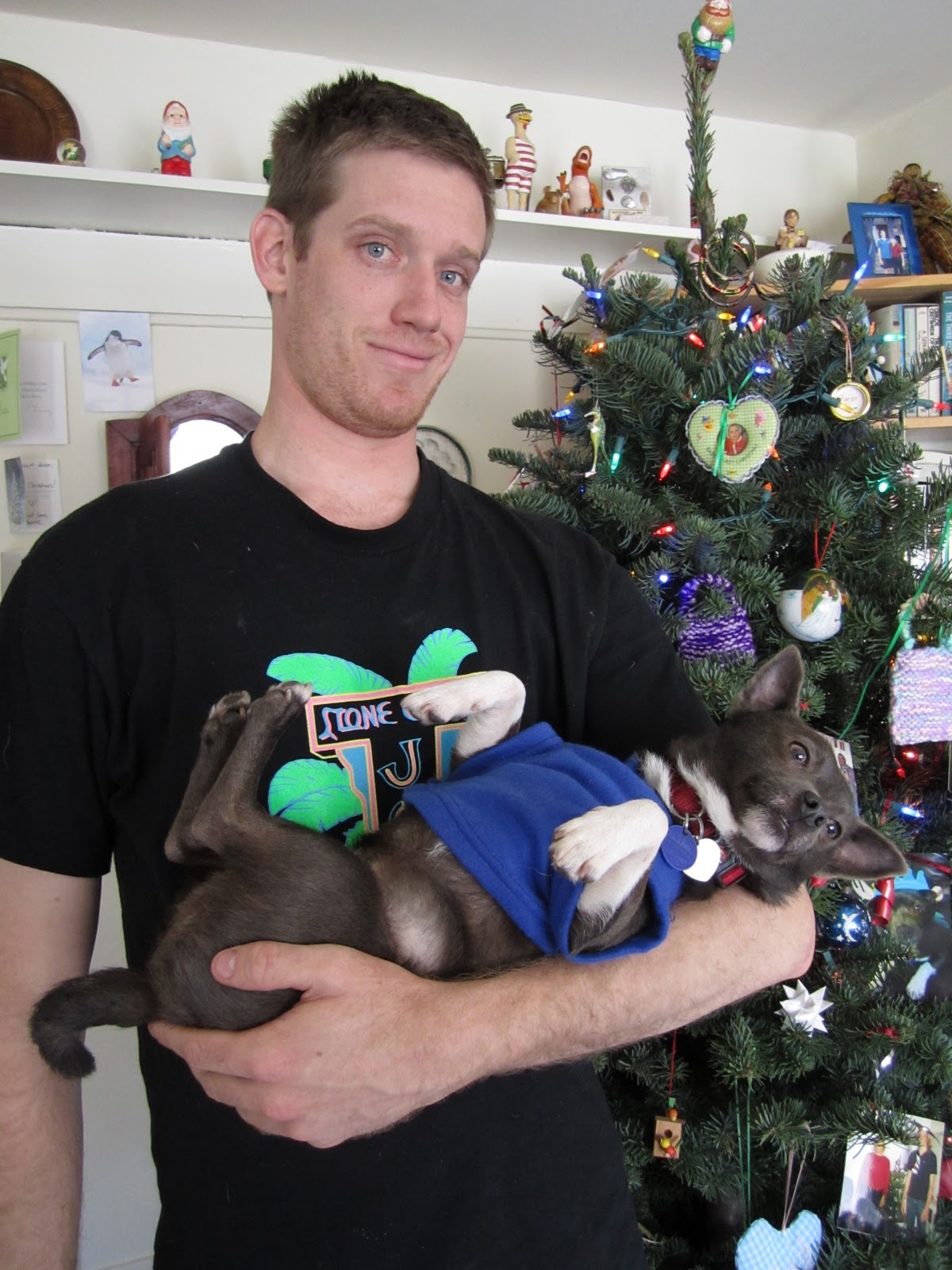 A few times since surgery, I have been close to tears, but critical mass was not reached and no tears fell. Yesterday morning while putzing around the apartment, medieval carols playing on the boom box, I suddenly was overcome with emotion. What emotion it was, I can't really say. It certainly wasn't sadness, but I can't say it was joy either. It was as if a backlog of all sorts of feelings came rushing forth in physical form without accompanying emotion.
The sensation was so powerful that, weeping, I dropped to my knees in front of the Christmas tree, which was already lit up. As tears streamed down my face, I said my thanks aloud for how very fortunate I am to have received a kidney. Most people are dead before they reach five years on dialysis, and I was just shy of two years before I received one. The vast majority of people die before a kidney is offered.
I know how fortunate I am to have had so many people pulling for me. Even if you don't believe in God or some universal force, you have to realize that maybe a hundred people concentrating their thoughts, their energy, and their visualizations on my healing is powerful. The concentrated intention of one person is a force to reckon with, but if you multiply that a hundredfold, you've got something unstoppable. I am so grateful for this assistance.
After about five minutes of weeping, I got up and resumed my putzing. That release was cleansing and complete. No need to dwell on it or overanalyze it. It simply was for five minutes, and then it was gone without leaving any residue.
Post-op Miscellany
A few observations and experiences that don't necessarily warrant individual posts:
 * In the week following surgery, I had a lot of dark dreams. I hesitate to call them nightmares because I wasn't scared, but their content was potentially frightening. Shadowy presences, demons, malevolent entities, darkened rooms. Other dreams were lucid, perhaps even astral travel. They were like waking life with no sudden shifts from venue to venue.
On reflection, this makes sense that the subconscious should be stirred up following surgery. The surgeons cut deep into my physical core, and so the core of my psyche would also be disrupted. Gunk like blood, tissue, and fluids drained from the body post-op, so no doubt psychic gunk also was released. I don't interpret this as unacknowledged fears on my part, as I am really good at soul-searching, and not a whole lot about my inner workings escapes my scrutiny and contemplation. I was very calm going into surgery, prepared for wherever it took me, even into death. Once you reconcile with the prospect of death, you can face just about anything.
* I have managed the pain exceedingly well. Post-op I had morphine only twice, one dose a half dose, and one Tylenol. Then nothing until I got home. One day the pain was so bad I took two Tylenol. Other than those four times, I have had nothing. The incisions are generally on the level of discomfort, not pain, so there isn't really any justification for pain meds, which I feel are more trouble than they're worth.
* I started driving one day shy of two weeks post-op. Though six weeks is the recommended resumption of driving, I didn't see any reason why I should wait that long, since I wasn't taking pain meds and didn't feel impaired.

* Have been very careful about staying away from people with colds. Diana had invited me over to her mom's house for Christmas, but then called today to tell me she was coming down with something. I thought it best to stay home with Rasputin. Pinky is doing so well that I don't want to do anything to disturb her.
I canceled the annual holiday tradition of caroling for brandy this year in order to avoid infections. Sure missed caroling from one stranger's door to another and brightening the hearts of many and confusing and/or embarrassing a few others. To view past years' posts on caroling for brandy, see 2009, 2008, and 2007.http://heidisheart.blogspot.com/2007/12/caroling-in-carol-park.html
I canceled the annual holiday tradition of caroling for brandy this year in order to avoid infections. Sure missed caroling from one stranger's door to another and brightening the hearts of many and confusing and/or embarrassing a few others. To view past years' posts on caroling for brandy, see 2009, 2008, and 2007.http://heidisheart.blogspot.com/2007/12/caroling-in-carol-park.html
* Before surgery, I had bought a foot-high living tree from the market because I didn't know how long I'd be in the hospital. When I got home only four days following surgery, I really wanted a tree, and damn if we didn't get the best tree we've ever had. Enough room to put up all the ornaments.
* Pictured here with snowflake sunglasses--Elton John, step aside!--and a bird whistle from Georgette, a pixie of a gal who lives in Florida and each birthday and Christmas sends me gifts that make me giggle. Also a cashmere scarf from my neighbor Annie. I've always loved cashmere but have never owned any until now. A generous gift.
Sunday, December 19, 2010
More Hospital Photos
 Here are a few photos from the morning after surgery. The woman with the mask is Janet, my friend and neighbor. The woman in bed is Brandie, the woman who gave me her kidney. The guy on the cell phone is Constantine, one of my favorite nurses, who hailed from Romania. Look how I'm beaming!


Weight Loss, Bruising, Increased Pain
One of the most remarkable things post-surgery has been the tremendous loss of water weight. I went from 151 the day of surgery to 136 four days following surgery. That loss of excess fluids in itself has so improved my energy. The fluids were constricting my lungs and my heart, wearying me, exhausting me. With those fluids gone, I'm so much lighter and without constriction.
I truly have been struggling with excess fluids for about a dozen years. A lot of this manifested as cardiac symptoms, but the root cause was the buildup of fluids. That's why I have been telling people that this is the best I've felt in 12 years. And, of course, the healing process is far from over. Three months from now, I may just feel like a teenager again.
The bruising of my belly has expanded. Much of my tummy is now black and blue.
And this morning I took two Tylenol because the incision was not just uncomfortable but painful. This is only the fourth time I have taken pain meds post-op and the first time since leaving the hospital.
Tomorrow is another clinic visit at UCLA. Up at 4:20 a.m., leave the apartment by 5, so that I can get to the lab when it opens at 6. Whew!
Friday, December 17, 2010
The Drain Bag is Draining on Me!
During transplant surgery, my peritoneal dialysis tubing was removed. For almost two years I had had a foot-long tube protruding from my abdomen through which I hooked up to tubing from my dialysis machine every night. Since Pinkie, my new kidney, was off to a fantastic start even in the OR, the surgeon removed all this unsightly mess. But he put something similar on the other side of my belly--a length of tubing attached to an avocado-sized plastic bulb to catch blood and fluids post-op, known as the Jackson-Pratt surgical drain, named, I suppose, for the inventors.
For the first week after surgery, I could never go more than two hours without emptying it. Sometimes only an hour. That meant very little sleep.
For the first week after surgery, I could never go more than two hours without emptying it. Sometimes only an hour. That meant very little sleep.
In the last few days, it has leaked at the exit site, soaking the bandage and wetting my shirt and pants. Some days I have had to change my clothes four or five times.
Plus, pieces of tissue make their way down the tubing and into the bulb, but often they are so thick and large that they block the flow, again causing leakage at the exit site.
Today during my clinic visit, the surgeon said that I should no longer create a vacuum in the bulb by squeezing it tight after emptying. He said that, at this point, healing needs to take place, and a vacuum might be pulling out more fluid and tissue than is conducive to healing. But if there isn't a vacuum, then excess fluid can't escape through the tube and must instead leak into the bandage.
I got the bright idea to use Depends. I figured that I could pull them past the bandage covering the exit site. Even though the bandage may get soaked, my clothes will not get wet because the fluids will be absorbed by the Depends.
Well, so far that's working better than nothing, but not that great. After all, Depends were made for urine, and the exit site at my waist is a long way from that area. There isn't a lot of absorbant material in the waist band because generally that's not where it's needed.
Oh, well, this too will pass, though one cheery friend told me his father-in-law wore a Jackson-Pratt for three months! Even if that turns out to be the case, it'll all be worth it for Pinkie.
Thursday, December 16, 2010
My Poem for Janet
Below is a poem I wrote for my next-door neighbor Janet prior to our surgeries. I hoped that in some small measure this shows my deep gratitude.
For those of you who are good Catholics or perhaps religious studies majors, let me make it very clear that I know the difference between the Feast of the Immaculate Conception (Dec. 8, the day on which I had transplant surgery) and the Annunciation of the Blessed Virgin Mary (March 25). The former entails the conception of Mary without sin, i.e. her parents actually had sex but it was really clean sex and so she was born without sin and remained without sin so that she could be a pure vessel for the baby Jesus. In contrast, the annunciation is when the angel visited Mary and she became "with child" without having sex. But I have taken poetic liberty to intertwine these two in my poem.
Conception and Rebirth
(for Janet)
My mother gave birth to me,
but on this Feast of the Immaculate Conception,
you have given me a second life.
Without you, I would be chained
to a dialysis machine every night until I die,
becoming ever weaker, hardly able to cross the room.
Like Mary, who was touched by an angel
and felt the stirrings of baby Jesus within her loins, Like Mary, who was touched by an angel
I too sense the beginnings of a new life within me,
awakened through the gift of your kidney,
one link in an eight-person cross-country chain.
This newness in me and in three other patients
Immaculately conceived through the kidneys of four strangers.
Now freed of tubing, tape, and gauze,
without holes in our arms and our bellies,
we will once more hike, swim, lounge in Jacuzzis,
canoe, camp, surf, take baths,
drink as much water as we like,
travel the world with ease,
and get a good night’s sleep.
As a Buddhist, you might see this transformation in a different light,
as a part of you reborn in another.
Because a man outside Philadelphia gave his kidney to a man in L.A.,
I received his wife’s kidney
and you gave one of yours to someone in Virginia,
whose friend completed the chain,
giving to a patient with a rare blood type in San Francisco.
Four rebirths without four deaths.
A miracle in any religion,
in any way of conceiving the world.

Don't Ever Sell the Kindness of Strangers Short
Pictured here is my next-door neighbor Janet the morning after donating one of her kidneys on my behalf. By her side is her equally compassionate husband, Dana. She's wearing a scarf and hat handmade by Susie, the friend who donated one of her kidneys to her best friend's husband in the summer of 2009.
Though I've posted previously about the miracle of strangers stepping forward, this message bears repeating.
In late June of 2009, I moved into the apartment at which I currently reside. I had been walking in the neighborhood when I spied a FOR RENT sign that included the line "pet friendly." Exactly what I had been looking for, since I really wanted to get a dog. During that summer, I had several paramedic dramas and hospitalizations. Janet came to the rescue, scooping up a very protective Rasputin who would not let the paramedics near me. When I was home, we also went for afternoon walks with our dogs. So basically we were friendly neighbors but not yet friends when, six weeks after I'd moved in, she said she wanted to be my donor.
That was back in August of 2009, but I did not get on the transplant list until June 16 of this year. I had to fight and scratch to get there, having triple bypass surgery in November 2009 and then going through the long recovery process following a hip fracture in March of this year. Once I had graduated from a walker to a cane to my own unaided two legs, I started an aggressive cardiac rehab program to get my heart in good enough shape to pass the necessary tests. Finally after I was on the list, Janet could begin her testing to see if she was sufficiently healthy and blood type-compatible.
When we found out that Janet was A blood type and I'm O, we started looking into paired donations. To hedge my bet, Susie wrote a solicitation letter on my behalf. A former student of mine saw it and forwarded it to his friend Cindy in Phoenix, a 26-year-old who up until the end said that she would be my backup if this transplant didn't pan out.
One of the big messages of all this is that you never know from whom help will come. We tend to think that friends and family will step up to the plate, but that isn't necessarily true. They may have fears or hesitations or they may feel that they can help in other ways, such as my son who has been ever-ready to help all along. Had he been my donor, who would have done all the things he has currently been doing? Everyone has his or her role, even if that role seems to be no role. They perhaps are silent, do not send emails or cards, do not call, but are perhaps saying prayers or lighting candles or visualizing positive outcomes. Or they help out afterwards with shopping or cooking or, as I had this morning, a fantastic massage.
 The fact that I moved next door to the woman who would donate on my behalf--what are the chances! That two strangers would want to save my life is something that continues to amaze me. The beauty of Janet's gift and Cindy's unflinching offer are miracles in themselves. Of course, add to this the miracle of me even getting on the list--the initial Kaiser transplant panel and the initial consulting UCLA surgeon wanted to nix me, but I was persistent, making my way through about a dozen paramedic dramas, a half dozen hospitalizations, bypass surgery, a broken hip, months of rehab for my heart and my leg, and an unending barrage of doctor visits, nightly dialysis, tests, tests, and more tests. And then to think I survived the last couple months when I was in such dire fluid overload and dialysis just wasn't working any more that I struggled to do the simplest tasks, like walking across the room or getting dressed, all the while doing my best to keep this from everyone. It sure seems as if the forces of the universe were in alignment for me to make this happen.
So thank you, thank you, thank you to Janet for the gift of her kidney to a man in Virginia so that I could receive one from Brandie, my actual donor. Thanks to Brandie for literally giving me life. And thanks to Cindy for faithfully standing in the wings, ever ready to give of herself should other options fail. The kindness of strangers. Don't ever sell that short.
Though I've posted previously about the miracle of strangers stepping forward, this message bears repeating.
In late June of 2009, I moved into the apartment at which I currently reside. I had been walking in the neighborhood when I spied a FOR RENT sign that included the line "pet friendly." Exactly what I had been looking for, since I really wanted to get a dog. During that summer, I had several paramedic dramas and hospitalizations. Janet came to the rescue, scooping up a very protective Rasputin who would not let the paramedics near me. When I was home, we also went for afternoon walks with our dogs. So basically we were friendly neighbors but not yet friends when, six weeks after I'd moved in, she said she wanted to be my donor.
That was back in August of 2009, but I did not get on the transplant list until June 16 of this year. I had to fight and scratch to get there, having triple bypass surgery in November 2009 and then going through the long recovery process following a hip fracture in March of this year. Once I had graduated from a walker to a cane to my own unaided two legs, I started an aggressive cardiac rehab program to get my heart in good enough shape to pass the necessary tests. Finally after I was on the list, Janet could begin her testing to see if she was sufficiently healthy and blood type-compatible.
When we found out that Janet was A blood type and I'm O, we started looking into paired donations. To hedge my bet, Susie wrote a solicitation letter on my behalf. A former student of mine saw it and forwarded it to his friend Cindy in Phoenix, a 26-year-old who up until the end said that she would be my backup if this transplant didn't pan out.
One of the big messages of all this is that you never know from whom help will come. We tend to think that friends and family will step up to the plate, but that isn't necessarily true. They may have fears or hesitations or they may feel that they can help in other ways, such as my son who has been ever-ready to help all along. Had he been my donor, who would have done all the things he has currently been doing? Everyone has his or her role, even if that role seems to be no role. They perhaps are silent, do not send emails or cards, do not call, but are perhaps saying prayers or lighting candles or visualizing positive outcomes. Or they help out afterwards with shopping or cooking or, as I had this morning, a fantastic massage.
 The fact that I moved next door to the woman who would donate on my behalf--what are the chances! That two strangers would want to save my life is something that continues to amaze me. The beauty of Janet's gift and Cindy's unflinching offer are miracles in themselves. Of course, add to this the miracle of me even getting on the list--the initial Kaiser transplant panel and the initial consulting UCLA surgeon wanted to nix me, but I was persistent, making my way through about a dozen paramedic dramas, a half dozen hospitalizations, bypass surgery, a broken hip, months of rehab for my heart and my leg, and an unending barrage of doctor visits, nightly dialysis, tests, tests, and more tests. And then to think I survived the last couple months when I was in such dire fluid overload and dialysis just wasn't working any more that I struggled to do the simplest tasks, like walking across the room or getting dressed, all the while doing my best to keep this from everyone. It sure seems as if the forces of the universe were in alignment for me to make this happen.
And then that I should feel so fantastic so shortly after surgery. Several nurses said they had never seen a recipient get up and walk the halls the morning after surgery or seen someone been released in four days, five days being the absolute minimum.
But I feel better than I've felt in more than a dozen years. In the decade prior to the onset of dialysis, my heart was dragging on me. For years I didn't lie down but rather slept sitting up because the weight of my own body on my chest was too constrictive. Everything from walking a few feet to climbing a flight of stairs to doing the laundry was a personal challenge. And yet I was often working 60 hours a week at several jobs, including teaching, freelance editing and writing, and massage therapy. Plus taking care of my mother for two years. It is a miracle I made it through this without keeling over.
Wednesday, December 15, 2010
Government Waste, an Up-Close Look
As irony would have it, on the same day that I opened the letter from the IRS, I called Kaiser's peritoneal dialysis clinic to see if I could have Aaron return the unopened supplies so that someone else could use them or so they could be used for training new patients. I was told that I would have to destroy the supplies, that they could not be used by others. I called Baxter, the supply company, and was told the same thing. Baxter said that a driver could pick up the boxes on Jan. 6, but that Baxter would not reroute them. I told the clerk to forget it, I wanted to get rid of the stuff ASAP so that I could be done with my bedroom as a warehouse and get back to my bedroom as a bedroom.
The reason this is ironic is that every dialysis patient in the country, as of 1984, is on Medicare, regardless of age. If you're 2 years old and are on dialysis, you receive Medicare. Here one arm of the government is attempting to take my money, and another arm of the government refuses to allow me to save it money.
And we're not talking about chump change here. Every night for the past 22 months, I used three bags of dialysate at $75 a pop, or $225 in solution alone. I had approximately 30 unopened solution boxes, approximately $4,500! Add to that the fancy, single-use cassettes with tubing to each bag, to me, and to the drain jug, and the unopened extension lines that allowed me to move more than 12 feet from my machine, and the unopened box of 100 iodine-tipped mini-caps that seal the end of the transfer set each morning, and you can see we're approaching five grand, stuffed under my bed and stacked high against the walls of my bedroom.

The only saving grace is that Ed, the friend who came over to help with the destruction, is a resourceful guy who could use some of the tubing, the drain jug, and a few of the very sturdy dialysate boxes. Also, the Baxter rep said the dialysate makes excellent fertilizer, so Aaron emptied a half dozen bags on my neighbor Janet's garden. The rest of the boxes, cassettes, and extension lines were recycled, but four large trash bags with the empty dialysate bags were tossed in the garbage.
What's more unbelievable is that with budget cuts, we could easily see a tightening of access to healthcare. Dialysis is an extremely expensive venture, one of the most expensive, if not the most expensive, Medicare costs. Costs driven up by this kind of waste. But when the Government Accounting Office (GAO) or Congress looks at the numbers, they won't see this ridiculous situation. They'll only see that dialysis patients are costing the country an arm and a leg, and that perhaps we should go the way of South Africa or Australia. The former has death panels as was once the case in this country, at which patients must prove their social worth in order to receive dialysis. Otherwise, they're left to die. In Australia, patients over 65 are not given dialysis, but are rather told by their physicians that they are too old to be viable.
What a crazy, mixed-up country we live in! How did things get so incredibly out of whack?
The reason this is ironic is that every dialysis patient in the country, as of 1984, is on Medicare, regardless of age. If you're 2 years old and are on dialysis, you receive Medicare. Here one arm of the government is attempting to take my money, and another arm of the government refuses to allow me to save it money.
And we're not talking about chump change here. Every night for the past 22 months, I used three bags of dialysate at $75 a pop, or $225 in solution alone. I had approximately 30 unopened solution boxes, approximately $4,500! Add to that the fancy, single-use cassettes with tubing to each bag, to me, and to the drain jug, and the unopened extension lines that allowed me to move more than 12 feet from my machine, and the unopened box of 100 iodine-tipped mini-caps that seal the end of the transfer set each morning, and you can see we're approaching five grand, stuffed under my bed and stacked high against the walls of my bedroom.

The only saving grace is that Ed, the friend who came over to help with the destruction, is a resourceful guy who could use some of the tubing, the drain jug, and a few of the very sturdy dialysate boxes. Also, the Baxter rep said the dialysate makes excellent fertilizer, so Aaron emptied a half dozen bags on my neighbor Janet's garden. The rest of the boxes, cassettes, and extension lines were recycled, but four large trash bags with the empty dialysate bags were tossed in the garbage.
I'm sure it all comes down to liability. Seems that's the case in 95 percent of decisions made in this country. Even though the dialysate did not expire for at least another year, even though it had been kept at a consistent temperature that was well within the established guidelines for safe keeping, even though I was willing to have Aaron and Ed do the heavy lifting and return the supplies at no charge to Medicare or the dialysis clinic, I suppose there is the FEAR that I would have opened the boxes, injected some dire substance into the bags, and resealed them again in an evil scheme to take down some luckless souls. Unbelievable.
What's more unbelievable is that with budget cuts, we could easily see a tightening of access to healthcare. Dialysis is an extremely expensive venture, one of the most expensive, if not the most expensive, Medicare costs. Costs driven up by this kind of waste. But when the Government Accounting Office (GAO) or Congress looks at the numbers, they won't see this ridiculous situation. They'll only see that dialysis patients are costing the country an arm and a leg, and that perhaps we should go the way of South Africa or Australia. The former has death panels as was once the case in this country, at which patients must prove their social worth in order to receive dialysis. Otherwise, they're left to die. In Australia, patients over 65 are not given dialysis, but are rather told by their physicians that they are too old to be viable.
What a crazy, mixed-up country we live in! How did things get so incredibly out of whack?
The IRS Can't Take my Kidney!
When I returned home from the hospital late Sunday night, I saw the pile of mail on my desk, but did not begin to tackle it until the next day. There among the cable company promotions (they still don't believe I don't have a TV) and charity solicitations was a thick packet from the IRS.
The IRS contends that my mother's taxes were incorrectly filed in 2008, and her estate--that's me--owes $18,419. A full $4,094 are penalties and interest. My goodness, you can get much better rates from the mob!
This is an ungodly amount, to be sure. A lot of years in the past decade, I haven't even netted $18K after business expenses were deducted.
But I looked at this letter with the same detachment as I did the cable company promos. I have a new kidney, I'm alive and feeling so much better than I have for a very long time, and at least for now, the IRS cannot take my kidney. Either the matter will be resolved and I'll pay nothing or a lot less, or I'll have to pay it off slowly over the course of my remaining years. But in either case, I am thankful to be alive. The bastards can't take that from me, though I believe that's the course down which we're heading.
Now that the super rich have gotten their tax cuts, the budget cuts will begin. More people will be made homeless, more people will starve, more people will receive inadequate education and therefore be stuck in low-end jobs, more people will die from lack of services. But it is so important that the rich get richer. That's what it's all about--reverse Darwinism, not survival of the fittest but survival of the most pampered and therefore the least strong.
Sunday, December 12, 2010
I'm Blowing This Joint Tonight!
Just heard from a very good-looking surgeon that I am being released tonight. My blood sugars are in decent control. I'm peeing up a storm. My creatnine level is in the normal range. My neck shunt has been removed, and the IV will soon follow. All is good.
Aaron is cleaning up the apartment, as he told me "it's a real mess." Then he's driving to UCLA to take me home to my own bed.
Doubtless I'll stay with Susie at some point when I'm attending clinic visits, but right now she's been doing so much for so many people, that I don't want to put anything more on her.
Thanks to all who have sent their love, their support, and their prayers. And thanks especially to the inner circle in the greater Long Beach area who have volunteered to help with grocery shopping, cooking, cleaning, rides, and laundry. This means an awful lot.
Saturday, December 11, 2010
Me in my Hospital Gown

Well, here are a few of the hospital photos. Not my cutest outfit, but look at that color in my face and the glow in my eyes! And these are taken on my first morning, post-op.


One with my wonderful surgeon, Dr. Veale.
Also Michelle, a former student of mine, who visited with me for a few hours this afternoon.

Not All Fun and Games at the Hospital
Another sleep-deprived night. The first night my vitals--blood pressure, blood sugar, temperature, oxygen--were checked every hour. The last two nights, every other hour. But that doesn't tell the whole story.
The insulin infusion is set to alarm every two hours to remind the nurse to check my blood sugar and then adjust the infusion setting. So sometimes the alarm rings for 20 minutes before she responds. I asked the charge nurse why the alarm can't ring on the nurse's watchband rather than in my ears. Oh, no, that's not possible, even though the nurse assigned to me only has one other patient--the kidney transplant patient next door to me.
Also, the damn heart monitor had to be changed out because it was constantly alarming for no reason. Then the replacement started alarming every 10 minutes. Finally someone had the bright idea to shut the alarm off.
Then the nurse had to clean my neck shunt of old blood at 4 in the morning. She took blood from the shunt at 5, but that was too early, so she had to take it again at 6. In between her checks of my blood sugar at midnight, 2, 4, and 6, the nurse's assistant came in on the off hours to check the rest of the vitals. Why couldn't these things be coordinated?
I have complained mightily to the doctors. Sleep deprivation is antithetical to health. It is during sleep that the body heals. A sleep-deprived person is open to stress, infection, and illness. And I am especially susceptible to all of these now that I'm on immune suppressants.
What's more, I have seen serious lapses in cleanliness, and I've called them out. I don't care if they think I'm a complaining bitch. The nurse comes into my room, washes her hand, puts on gloves, then begins touching the door, the cabinets, the computer, then wants to touch me. So I ask her to change her gloves before she does that. The worst was the gal who helped me wash up yesterday. I have so many lines and tubes attached to me that it's very hard to maneuver. She took a washcloth to my catheter and wiped around down there, then took the same washcloth to clean off the lead to my heart monitor, which was dangling at my knee, then to my horror, she puts the very same washcloth back inside me!
Yesterday I thoroughly cleaned my room, something I've taken to doing as soon as I feel up to it in the hospital. I got a canister of Chlorox beach wipes, put on gloves, and started wiping everything down--chairs, bed rails, cabinets, drawers, sinks, door knobs, light switches. I also picked garbage off the floor. You can't count on housekeeping to do any more than changing out the trash receptacles and taking away the dirty gowns.
Add to this, the bed is not at all comfortable. I was in it the first two nights and got a bad back ache. A nurse said this is partly due to the way a body is splayed during surgery. The arms are hooked above the head so that the surgeons don't have any loose skin or folds to deal with. On Thursday night I was more comfortable walking the hallways than lying in bed. Last night I tried the recliner. It was better, but still produced a back ache around 4. I could really use a good massage.
I finally got something by mouth yesterday night--two cups of beef broth. This morning, I had jello, grape juice, and chicken broth for breakfast. Such a treat after days of not eating or drinking.
One other thing: There was some thought that I might have had a heart attack while in surgery. Tests were run Thursday to check the level of a heart enzyme that is released during an attack. Thankfully, my level was normal.
Subscribe to:
Posts (Atom)